
 Ask Hadi

Flip a Roman coin from the 14th century and you will find, on one side, the Chi-Rho monogram, the first two letters of Christ's name in Greek. Now turn it over. On the other side: the sun god, Sol Invictus, radiant and unconquered, with the Latin inscription still legible after seventeen centuries.
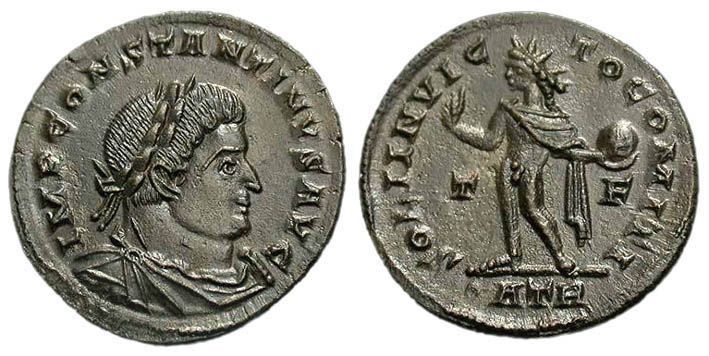
A bronze coin of Constantine I (c. 310 AD) with Sol Invictus, the unconquered sun god, on the reverse. Minted during the same period he declared himself a Christian emperor.
His name was Constantine. Christians call him a saint. But the Book of Daniel, a text that sits in both the Jewish and Christian canons, a text that is considered sacred, may call him something else entirely. And the prophecy does not stop with Constantine. It gives a timeline. And that timeline ends with Islam.
Before anything else, something needs to be stated clearly: you do not need the Bible to establish the prophethood of Muhammad ﷺ. The Qur'an stands on its own. But Islam has always affirmed that the earlier scriptures, despite their distortions, still carry traces of truth.
What follows is one of those traces, and it is remarkably bright.
What does Daniel chapter 7 actually say?
The 17th chapter of the Book of Daniel begins with a prophetic dream. Daniel, peace be upon him, sees four beasts rising from a churning sea. A lion with eagle's wings. A lopsided bear with three ribs in its teeth. A four-headed leopard with wings. And then a fourth beast so terrifying that the text cannot even name an animal for it. It has iron teeth. It devours everything. And from its head grow ten horns.
Then, while Daniel watches, a smaller horn pushes through, uprooting three of the others.
This little horn has human eyes and a mouth that speaks "great things against the Most High".

OLD TESTAMENT
“He shall speak pompous words against the Most High, Shall persecute the saints of the Most High, And shall intend to change times and law. Then the saints shall be given into his hand For a time and times and half a time.”
Danial 7:25Daniel asks for an interpretation. He is told: these four beasts represent four kingdoms. The ten horns are ten kings. And the little horn is a king who will come after them, different from all who preceded him, who will subdue three kings, persecute the righteous, change the sacred calendar, alter the law, and hold power for "a time, times, and half a time" before the kingdom is taken from him and given to the saints forever.
Every element of this prophecy maps onto documented, verifiable history.
The four kingdoms that all scholars agree on
Here is the remarkable thing about Daniel chapter 7: Jewish, Christian, and Muslim scholars, traditions that agree on almost nothing else, converge on the identity of these four kingdoms.
The lion is Babylon. The bear is the Medo-Persian Empire. The leopard is Greece. And the fourth beast with iron teeth is Rome.
Matthew Henry (1662–1714), one of the most widely read Bible commentators wrote: "The legs and feet of iron signified the Roman empire."
John Wesley (1765), the founder of Methodism, identified the fourth beast plainly: "The Roman empire."
The great German Old Testament scholars Keil and Delitzsch put it most directly: "According to the all but unanimous belief of both Jews and Christians, the empire indicated is that of Rome."
So, the 4th empire is the Roman, and the ten horns are ten kings of the Roman Empire. But which ten?
The ten Roman emperors who persecuted christians
Rabbi Saadia al-Fayoumi, one of the biggest intellects of medieval Judaism, argued in his commentary on Daniel that the prophecy refers to the most significant Roman rulers, the ones who defined an era, not every name on a dynastic list.
And if you narrow the count to the Roman emperors who ruled after Jesus, peace be upon him, and who systematically persecuted early Christians, you arrive at exactly ten. Starting with Nero. Ending with Diocletian, whose reign concluded in 305 AD.
But the most famous enumeration in the Western tradition belongs to John Foxe (1516–1587), whose Foxe's Book of Martyrs became one of the most influential texts in Protestant
“The first persecution of the Church took place in the year 67, under Nero.....Occasioned partly by the increasing number and luxury of the Christians, and the hatred of Galerius, the adopted son of Diocletian.”
Foxe list exactly ten major persecutions of Christians under Roman emperors: Nero (AD 64–68), Domitian (AD 90–96), Trajan (AD 98–117), Marcus Aurelius (AD 161–180), Septimius Severus (AD 202–211), Maximinus Thrax (AD 235–238), Decius (AD 249–251), Valerian (AD 257–260), Aurelian (AD 270–275), and Diocletian (AD 303–305).
Ten horns. Ten persecuting emperors. The Daniel chapter 7 prophecy holds with uncomfortable precision.
And then the eleventh figure appears.
The little horn in the book of Daniel: Why Christian interpreters change their method
The text reads:

BIBLE
“And the ten horns out of this kingdom are ten kings that shall arise: and another shall rise after them; and he shall be diverse from the first, and he shall subdue three kings.”
Daniel 7:24Another king. After the tenth. Different from all of them. The same word used for the ten is used for the eleventh.
And yet, when prominent Christian commentators reach this verse, something shifts. Some say the little horn in the Book of Daniel represents "the heresies that deny the divinity of Christ." He names Arianism. One reading even suggests atheist communism.
The same scholars who just identified ten specific, historical, named kings now decide the eleventh is not a king but an abstract concept. A heresy. The text says "another shall rise." Not "another idea shall emerge." The scholars who used rigorous historicism for the first ten horns abandoned their own method the moment the prophecy points somewhere they would rather not look.
Because the moment you ask who actually came after those ten emperors, who ruled with a policy opposite to theirs, who defeated three rival kings, who changed the religion, the calendar, and the law, you land on one name.
Constantine.
How Constantine matches every detail of Daniel’s little horn
Philip Schaff (1819–1893), the Swiss-born church historian whose History of the Christian Church remains one of the most respected encyclopedias in Western Christianity, provides the evidence without ever intending to fulfill a prophecy.
1- Constantine came after the ten persecuting emperors.
Diocletian, the last of Foxe's ten, abdicated in 305. Constantine was proclaimed emperor in 306.
2- His policy was the opposite of theirs.
The ten persecuted Christians. Constantine issued the Edict of Milan in 313, granting religious freedom for the first time.
3- He defeated three rival kings.
Schaff writes:
Three rivals. Three defeated. Constantine broke a promise of mercy to Licinius, his own brother-in-law, then killed Licinius's eleven-year-old son, his own nephew.
In 326, he killed his own eldest son, Crispus. "The very brightest period of his reign is stained with gross crimes, which even the spirit of the age and the policy of an absolute monarch cannot excuse."
4- He changed the day of rest.
On March 7, 321 AD, Constantine issued the first civil law enforcing Sunday rest. The decree, preserved in the Codex Justinianus 3.12.2, reads: "On the venerable day of the Sun, let the magistrates and people residing in cities rest, and let all workshops be closed."
In the original Latin, the phrase is venerabili die solis. Not the Lord's Day. Not the Sabbath. The day of the Sun
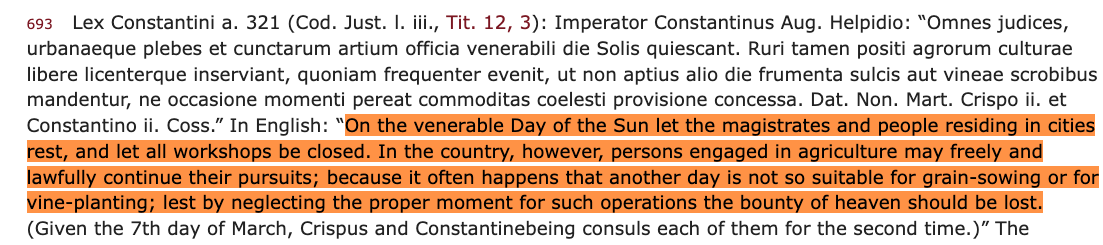
Philip Schaff himself translated this decree in his History of the Christian Church (Vol. III, p. 380)
Professor Hutton Webster of the University of Nebraska confirmed: "This legislation by Constantine probably bore no relation to Christianity; it appears, on the contrary, that the emperor, in his capacity of Pontifex Maximus, was only adding the day of the Sun to the other festival days of the sacred calendar" (Rest Days, p. 122).
There is a saying that captures this better than any scholarly analysis could:
When Christianity entered Rome, Rome did not become Christian. Christianity became Roman.
The timeline that points to islam: Three and a half centuries to jerusalem
Daniel 7:25 says the saints would be "given into his hand until a time, times, and half a time." The Jesuit Arabic Translation renders this as "a time, two times, and half a time." Three and a half time periods.
OLD TESTAMENT
“And he shall speak great words against the most High, and shall wear out the saints of the most High, and think to change times and laws: and they shall be given into his hand until a time and times and the dividing of time. But the judgment shall sit, and they shall take away his dominion, to consume and to destroy it unto the end.”
DANIEL 7:25-26Here is the CATCH. Here is the catch. Many Christian interpreters assume "a time" simply means one year, making the total three and a half years. But this is wrong, and here is why.
The word itself does not mean "year."
The Aramaic word used in Daniel 7:25 is 'iddan (עִדָּן), which means "a set period" or "a season." Daniel had a perfectly good word for year, shanah, and he used it elsewhere when he meant year specifically (Daniel 9:2).

The word by word Aramaic analysis of Daniel 7:25 from Bible Hub. The word 'iddan (עִדָּן, Strong's 5732) appears twice, both times translated as "a time," classified as a noun meaning period or season. Daniel did not use the Aramaic word for "year" here.
And they shall be given into his hand until a time and times and half a time.
Daniel 7:25

When Daniel meant "years," he used the word hashaniym (הַשָּׁנִים, Strong's 8141), a completely different word from the 'iddan he used in Daniel 7:25. Same prophet, same book, two different words. He knew the difference.
In the first year of his reign, I Daniel understood by the books the number of the years.
Daniel 9:2
The scale of the prophecy makes 3.5 years absurd.
This is a vision that tracks 4 empires across a thousand years. The ten horns alone span from Nero in AD 64 to Diocletian in AD 305, over two centuries. A prophecy that measures history in centuries does not suddenly shrink its most important prediction to a few months. The unit of time must be proportional to the scope of the vision.
The fulfillment test settles it.
The prophecy says that after this period "the kingdom and dominion shall be given to the people of the saints of the Most High" (Daniel 7:27). Three and a half years after Constantine took power brings us to approximately 309 AD.
Nothing happened. No kingdom changed hands. No saints received dominion.
But three and a half centuries after Constantine, in 637 AD, the Muslim forces entered Jerusalem and the holy city passed from the Roman empire to the people of Tawḥīd.
And the contrast between how the two eras ended and began says everything. Constantine entered history through blood, betrayal, and the merging of paganism with monotheism. Umar entered Jerusalem on a donkey, accompanied by a single servant. When Patriarch Sophronius offered him a place to pray inside the Church of the Holy Sepulchre, Umar refused, saying: "If I prayed here, future Muslims would use it as an excuse to convert this church into a mosque."
He then wrote a decree protecting the church. He allowed Jews, expelled under Byzantine rule, to return to the city for the first time in centuries.
Constantine burned books. Umar protected churches.
The questions this biblical prophecy about islam leaves behind
Did the Muslims arrange history so that Constantine would emerge after exactly ten persecuting emperors? Did they engineer his three rivals? Did they calculate that 340 lunar years after Constantine's rise would be the moment to enter Jerusalem?
Or did this prophecy, written in a book that Jews and Christians hold sacred, describe exactly what happened?
The references are cited. The history is documented. The coins still exist in museums. The prophecy is still in Daniel chapter 7, waiting for anyone willing to read both sides.
A coin has two faces.
A prophecy does not.
