
Prayer (Ṣalāh) — Five times a day. Every day.
Prayer in Islam is not a spiritual mood or a once-a-week ritual. It is a deliberate, repeated return to God, five times each day, at appointed times.
 QURAN
QURAN“So, (O Muslims,) when you have finished your Prayers, remember Allah (in all postures:) standing, sitting and (lying down) on your sides. And when (free of fear) you feel secure, establish Prayers (as prescribed). Verily, Prayer is obligatory for Muslims in accordance with the fixed timings.”
فَإِذَا قَضَيْتُمُ الصَّلَاةَ فَاذْكُرُوا اللَّهَ قِيَامًا وَقُعُودًا وَعَلَىٰ جُنُوبِكُمْ ۚ فَإِذَا اطْمَأْنَنتُمْ فَأَقِيمُوا الصَّلَاةَ ۚ إِنَّ الصَّلَاةَ كَانَتْ عَلَى الْمُؤْمِنِينَ كِتَابًا مَّوْقُوتًا ١٠٣
A connection point. Five times a day.
The Arabic word for prayer — Salah — comes from a root meaning connection. That is what it is. A connection point. Five times a day, you stop what you are doing and reconnect with God.
Prayer in Islam is not a vague spiritual mood or a once-a-week ritual. It is a deliberate, repeated return to God at appointed times.
Not because He needs your worship. Because a day without any pause for reflection is a day that slips by without meaning.
QURAN“And attend to your prayers, and practice regular charity, and bow down with those who bow down”.
وَأَقِيمُوا الصَّلَاةَ وَآتُوا الزَّكَاةَ وَارْكَعُوا مَعَ الرَّاكِعِينَ ٤٣
You wake up with purpose — the day begins with God, not with your phone
You break up your workday — a pause in the middle of everything
You are pulled back before the day runs away from you
You mark the transition from day to night with something intentional
You close your day with stillness — the last thing before sleep
About five minutes each time. Thirty minutes total across an entire day. The five prayers are anchors — they break up your day and pull you back to what matters.
Before you pray — Wudu (washing)
Before prayer, Muslims wash. Not because you are dirty — but because you are about to stand in front of your Creator. You prepare.


What breaks Wudu — requiring you to wash again before the next prayer
Five prayers.
Five daily moments of connection with Allah.
The times shift based on the sun and change slightly throughout the year. Most Muslims use an app or local mosque schedule. You do not have to pray at the exact minute — each prayer has a window of a couple of hours.
Each sequence of movements is called a rak'ah — one unit of prayer. The number of units varies per prayer, but the movements are always the same.
You wake up with purpose — the day begins with Allah, not with your phone
You break up your workday — a pause in the middle of everything
You are pulled back before the day runs away from you
You mark the transition from day to night with something intentional
You close your day with stillness — the last thing before sleep
How to perform the prayers
Every prayer follows the same structure. Whether it is Fajr at dawn or Isha at night, the body moves through the same sequence of positions — each one reflecting a deeper level of humility before God.


One unit of prayer is called a rak'ah. The number of units varies by prayer — two, three, or four. Here are the movements of prayer:
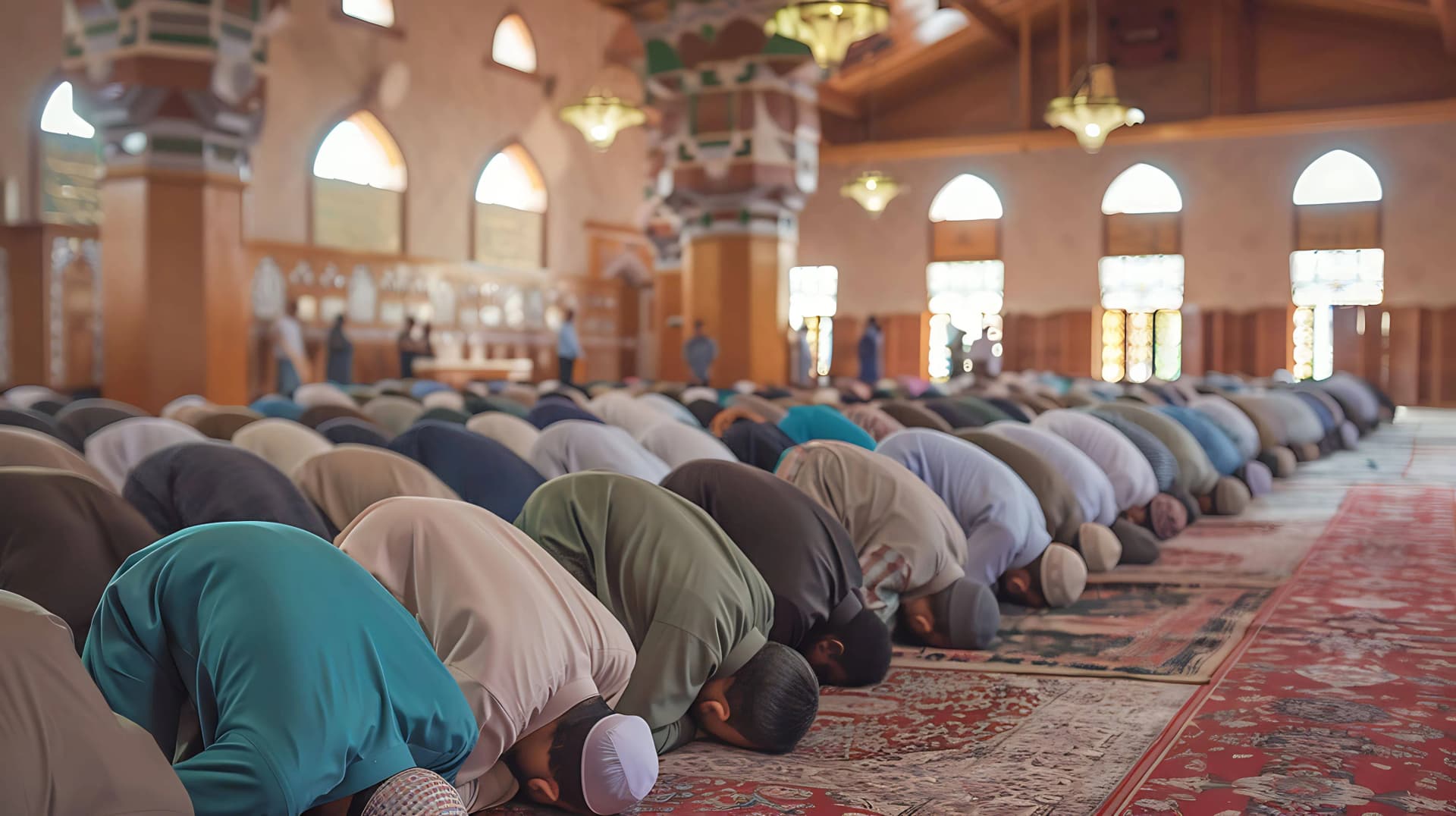
The heart of the prayer: Sujood — prostration
The prostration is worth mentioning separately.
It's the lowest physical position you can take. Forehead on the ground. The entire body folded down. In that moment, there's nothing between you and the earth — and nothing between you and God.
The Prophet Muhammad said that a person is closest to God during prostration.
It's not symbolic. You feel it. Whatever was weighing on your mind — deadlines, arguments, fears — it's still there when you get up. But for those few seconds, it's not the biggest thing in the room. Something else is.
That's hard to explain. It's easier to experience.

The Prophet Mohammed ﷺ said:
“The servant is closest to his Lord when he is in prostration.”
— Sahih Muslim · Hadith 482
The words of the prayer
Al-Fatiha (The Opening Chapter)
This is recited in every single unit of prayer. It's a conversation — you're asking God directly for guidance.
QURAN“In the name of Allah, the Compassionate, the Merciful. Praise be to Allah, Lord of the Worlds. The Compassionate, the Merciful. Master of the Day of Judgment. You alone we worship; and upon You, we call for help. Guide us along the straight path. The path of those You have blessed, not of those with anger on them, nor of the misguided”.
بِسْمِ ٱللَّهِ ٱلرَّحْمَـٰنِ ٱلرَّحِيمِ ١ ٱلْحَمْدُ لِلَّهِ رَبِّ ٱلْعَـٰلَمِينَ ٢ ٱلرَّحْمَـٰنِ ٱلرَّحِيمِ ٣ مَـٰلِكِ يَوْمِ ٱلدِّينِ ٤ إِيَّاكَ نَعْبُدُ وَإِيَّاكَ نَسْتَعِينُ ٥ ٱهْدِنَا ٱلصِّرَٰطَ ٱلْمُسْتَقِيمَ ٦ صِرَٰطَ ٱلَّذِينَ أَنْعَمْتَ عَلَيْهِمْ غَيْرِ ٱلْمَغْضُوبِ عَلَيْهِمْ وَلَا ٱلضَّآلِّينَ ٧
In Bowing
“Glory be to my Lord, the Great”. Repeat 3 times or more
In Prostration
“Glory be to my Lord, the Most High”. Repeat 3 times or more
In Tashahhud
“All greetings, prayers, and pure words are for Allah.
Peace be upon you, O Prophet, and the mercy of Allah and His blessings.
Peace be upon us and upon the righteous servants of Allah.
I bear witness that there is no god but Allah, and I bear witness that Muhammad is His servant and Messenger.”
Then (in the final sitting), you continue with:
“O Allah, send prayers upon Muhammad and upon the family of Muhammad, as You sent prayers upon Abraham and the family of Abraham. Indeed, You are Praiseworthy, Glorious.
O Allah, bless Muhammad and the family of Muhammad, as You blessed Abraham and the family of Abraham. Indeed, You are Praiseworthy, Glorious.”
Why Arabic?
The formal prayer is performed in Arabic.
It's not that Arabic is sacred on its own, but that the Quran was revealed in Arabic and prayer includes its original recitation. Translations help with understanding, but the prayer itself is done in Arabic.
For new Muslims, this can feel difficult at first, but the actual phrases are few—mainly Al-Fatihah and a small set of short expressions—and they're usually memorized within weeks.
You don't need to be fluent in Arabic, just familiar enough to perform the prayer.
And outside of the formal prayer, you can speak to God in whatever language you think in. There's no restriction on that.