
Hajj: The Journey of a Lifetime
Millions of people. One place. One purpose. No ranks, no titles, no distinctions — just souls standing before God.
 QURAN
QURANAnd proclaim the ±ajj (Pilgrimage) aloud amongst the people. They will approach you on foot and (mounted) on all lean camels, coming by distant tracks—
وَأَذِّن فِي النَّاسِ بِالْحَجِّ يَأْتُوكَ رِجَالًا وَعَلَىٰ كُلِّ ضَامِرٍ يَأْتِينَ مِن كُلِّ فَجٍّ عَمِيقٍ ٢٧
What is Hajj
Hajj takes place during the 12th month of the Islamic calendar (Dhul Hijjah), over five to six days. Muslims travel to Mecca — the city where the Ka’bah stands. The Ka’bah is a simple, cube-shaped structure that was built by the Prophet Abraham (Ibrahim) and his son Ishmael (Isma’il) as the first house of worship dedicated to Allah. Muslims do not worship the Ka’bah. They worship God. The Ka’bah is a direction — a unifying point that every Muslim on earth faces when they pray. During Hajj, pilgrims perform rituals linked to Abraham, Hagar, and Ishmael—acts of worship that connect them to Allah and unite them with Muslims worldwide.
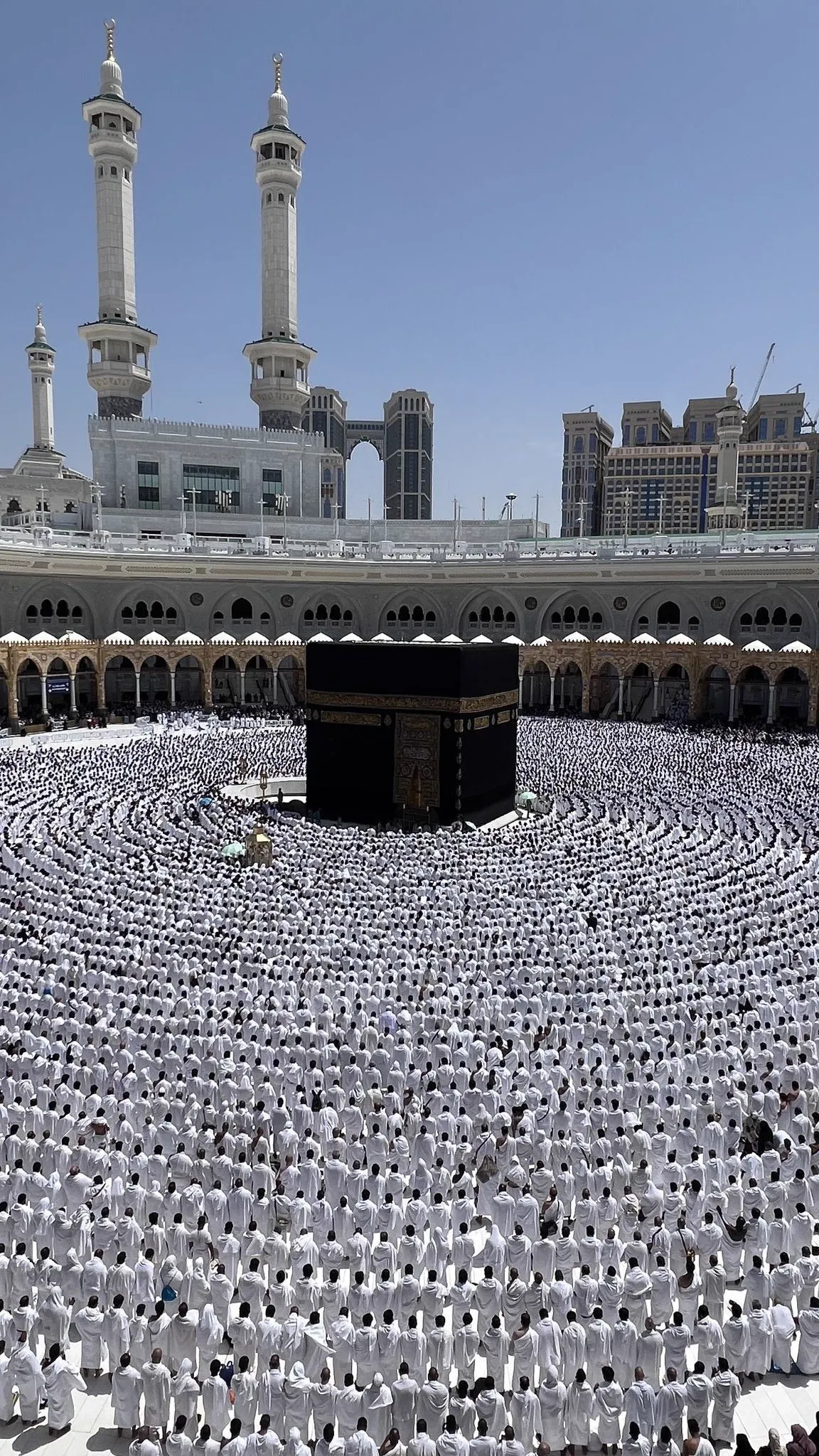
Everyone arrives equal
Before entering the sacred state of Hajj, men put on two simple white, unstitched cloths called Ihram. No designer labels. No suits. No distinctions. A king wraps himself in the same cloth as a laborer. Women wear simple, modest clothing — there is no single required garment, but simplicity is the point. The Ihram is not just clothing. It is a state. When you enter Ihram, you are saying: I have left behind my status, my identity markers, my worldly self. I am here as a servant of God and nothing else. You also agree to a set of restrictions — the point is total focus. You are not here for yourself.

Hajj is not the place for conflict. The environment is sacred — pilgrims are required to maintain patience and peace toward everyone around them.
Altering the body is suspended. You are in a state of consecration — your physical self is offered to God as it is.
The sensory indulgences of ordinary life are removed. You arrive stripped of adornment, equal in scent as in cloth.
Even the taking of animal life is suspended. The sacred state extends beyond you — it encompasses the space around you.
The entire self — physical, emotional, relational — is redirected. Nothing competes with the focus of these days.
The Point
These restrictions are not punishments. They are a complete narrowing of focus. You are not here for yourself — you are entirely oriented toward God.
The rituals of Hajj: five days that change everything
Hajj is not one act of worship. It is a sequence of lived rituals spread across five days — each one connected to the story of Abraham, Hagar, and Ishmael. You do not watch the story. You live it.
Tawaf and Sa’i
Pilgrims arrive in Mecca and perform Tawaf — walking around the Ka’bah seven times in a counterclockwise direction. Millions of people circling one point, all saying the same prayers, all facing the same center. Then they walk briskly between two small hills called Safa and Marwa — seven times. This traces the path of Hagar, mother of Ishmael, who ran between these hills searching for water for her infant son. God answered her desperation with the well of Zamzam, which still flows today.
The Day of Arafah
Pilgrims travel to the plain of Arafah and stand from noon until sunset — praying, crying, asking God for forgiveness. There are no rituals here. Just you and God, under the open sky, with nothing in between. It is considered the single most powerful day of the Islamic year for forgiveness — and the most emotionally overwhelming moment of Hajj.
“Hajj is Arafah.”
Muzdalifah, the Stoning, and the Sacrifice
After sunset at Arafah, pilgrims move to Muzdalifah, where they spend the night under the open sky and collect small pebbles. The next morning, they travel to Mina and throw pebbles at three stone pillars — a symbolic rejection of the temptations Satan placed before Abraham when he was tested. This is also the day of Eid al-Adha — when Muslims worldwide sacrifice an animal in remembrance of Abraham’s willingness to sacrifice his son in obedience to God. God, in His mercy, replaced the son with a ram. The meat is distributed to family, friends, and the poor.
Continued stoning and farewell Tawaf
Pilgrims continue the stoning ritual over the next two days, perform a final Tawaf around the Ka’bah, and prepare to leave. The farewell Tawaf is often the most emotional moment — saying goodbye to the House of God, not knowing if you will return.
It is not about the place. It is about what it does to you.
Hajj is designed to break you down — gently, completely — so that God can rebuild you. Three things happen in those five days that nothing else in life produces.
You realize how small you are — and how free that makes you.
Standing shoulder to shoulder with three million people, all equal, all asking the same God for mercy.
A reset of the entire soul — not a memory, not a trip. A reset.

“Whoever performs Hajj and does not commit any obscenity or transgression shall return — free of sin — as on the day his mother bore him.”
Once in a lifetime — if you are able
Hajj is required once in a lifetime for every Muslim who meets two conditions. If you cannot afford it, or your health does not allow it, Hajj is not required of you. God does not burden a soul beyond its capacity. The sincere intention to go — when the means become available — is itself honored by God.
Physical ability
You must be healthy enough to make the journey and perform the rituals. The elderly or severely ill are not required to go.
Financial ability
You must be able to afford the trip without putting your family into hardship, and after settling your debts. Hajj cannot be performed with borrowed money you cannot repay.
Many Muslims save for years — sometimes decades — to make this journey. For many, it is the single most anticipated event of their lives.
QURANThere are manifest signs in it, (one of which is) the station of Ibrahim (Abraham). Whoever enters it attains safety and protection; and the Pilgrimage to this House is prescribed for the people for the sake of Allah whoever may afford its journey; and whoever denies (it), then indeed Allah is Self-Sufficient, Beyond Need of all the worlds.
فِيهِ آيَاتٌ بَيِّنَاتٌ مَّقَامُ إِبْرَاهِيمَ ۖ وَمَن دَخَلَهُ كَانَ آمِنًا ۗ وَلِلَّهِ عَلَى النَّاسِ حِجُّ الْبَيْتِ مَنِ اسْتَطَاعَ إِلَيْهِ سَبِيلًا ۚ وَمَن كَفَرَ فَإِنَّ اللَّهَ غَنِيٌّ عَنِ الْعَالَمِينَ ٩٧
A story you already know
Hajj is not a new tradition. It is the continuation of a story that stretches back thousands of years — the story of one God, one family, one act of obedience at a time.
Abraham and his son Ishmael built it as a house of worship for the One God. When pilgrims circle it today, they are circling a structure tied to a covenant between God and Abraham that predates Islam by thousands of years.
Hagar ran between these two hills searching for water for her infant son Ishmael. God answered her desperation with the well of Zamzam, which still flows beneath Mecca today. Pilgrims walk the same path she ran.
God tested Abraham by commanding him to sacrifice his son. Abraham obeyed. God, in mercy, replaced the son with a ram. Every year on Eid al-Adha, Muslims around the world mark that moment of divine mercy with a sacrifice of their own.
As Abraham was tested, Satan whispered temptations to turn him away. Abraham refused and cast stones at him. Pilgrims in Mina do the same — a declaration that no temptation will turn them from obedience to God.
 THE BIBLE
“By faith Abraham obeyed when he was called to go out to a place he was to receive as an inheritance. And he went out, not knowing where he was going.”
THE BIBLE“By faith Abraham obeyed when he was called to go out to a place he was to receive as an inheritance. And he went out, not knowing where he was going.”
Three million people, one voice
Every continent. Every language. Every skin color. Every economic class. One place. One purpose. One God.
There is no VIP section at Arafah. There is no fast lane around the Ka’bah. A billionaire stands next to a farmer. A professor sleeps on the ground beside a taxi driver. Whatever structure the world uses to separate people, Hajj removes it — quietly and completely. Hajj does not just bring you closer to God. It brings you closer to everyone else who is trying to reach Him.
Malcolm X letter after performing Hajj in 1964
“I have never before seen sincere and true brotherhood practiced by all colors, all races, here in this ancient Holy Land. It changed the way I understood both Islam and humanity.”