
 Ask Hadi
In a colony of 60,000 honey bees, nearly every single one is female. The queen is female, and tens of thousands of workers that build the comb, guard the entrance, forage for nectar, and convert it into honey are all female.
The males, called drones, number only a few hundred. They cannot sting, cannot forage, and cannot produce wax. Their sole biological function is to mate with the queen.
It is the foundational fact of honey bee biology. And it was not confirmed until the invention of the microscope in the 17th century.
A hive of 60,000 females
A honey bee colony (Apis mellifera) operates with three castes: one queen, several hundred drones, and 20,000 to 60,000 workers. The queen is the only sexually developed female. She lays all the eggs. But the workers, every last one of them female, do everything else.
They secrete wax from glands on their abdomens to build the honeycomb. They leave the hive to collect nectar from flowers, storing it in a specialized organ called the honey stomach (or crop), which is separate from their digestive stomach.
For most of recorded history, humans assumed the opposite. The ancient Greeks, including Aristotle, believed the large leader bee was a king. The assumption persisted for centuries. It was not until 1586 that the Spanish naturalist Luis Mendez de Torres first proposed the leader bee was female.
Luis Méndez de Torres was a Spanish entomologist who first observed that the largest bee in the colony was an egg-laying female and not a male king as previously thought. In his 1586 treatise 'Short Tractate on the Cultivation and Care of Beehives' he did not use the term 'queen bee', but 'maessa de enjambre' which means 'mistress of the swarm'
Three verbs, all feminine, a grammatical detail invisible in translation
In Surah An-Nahl (chapter 16, "The Bee"), the Quran addresses bees in verses 68 and 69. In English translation, the gendered grammar is invisible. But in the original Arabic, every verb commanding the bee is conjugated in the feminine form.
Three key verbs appear in these verses: ittakhidhi (take/build), kuli (eat), and usluki (follow). All three carry the feminine singular imperative suffix ي (ya).
Three key verbs appear in these verses: ittakhidhi (take/build), kuli (eat), and usluki (follow). All three carry the feminine singular imperative suffix ي (ya).
Why the verb endings matter
The Quran specifically addresses the bees performing the work of the hive, the building, foraging, and honey production, using feminine verb forms. Modern entomology confirms that these tasks are performed exclusively by female worker bees. Male drones do not build, do not forage, and do not produce honey.
The verse also uses the term butuniha ("from her bellies"), a feminine singular pronoun pointing to the individual female bee. Modern anatomy confirms that the honey bee has a specialized crop (honey stomach) separate from its digestive ventriculus, effectively giving it more than one abdominal compartment involved in honey processing.
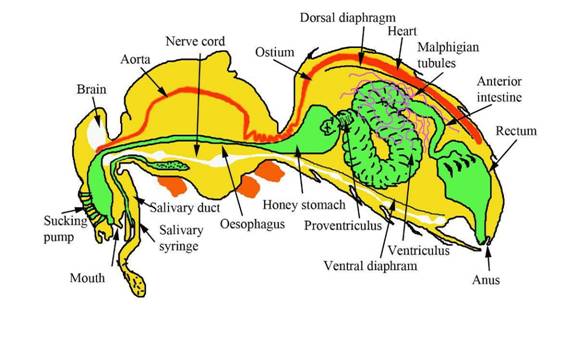
The honey bee has two distinct stomach compartments: the honey stomach (crop), where nectar is stored and transported, and the ventriculus, where digestion occurs. The proventriculus acts as a one way valve between them. The Quran uses the word بُطُونِهَا (butuniha), meaning "from her bellies," a plural noun with a feminine singular pronoun, pointing to multiple abdominal compartments inside a single female bee.
A thousand years before the first microscope
The Quran was revealed in the 7th century CE. Jan Swammerdam confirmed that worker bees are female under the microscope in the 1670s, more than a thousand years later. For most of that interval, the dominant assumption in both European and Middle Eastern traditions was that the hive was ruled by a king and worked by male laborers. The Arabic text of Surah An-Nahl does not make that assumption.
Three feminine verbs. A plural noun for stomach. A singular feminine pronoun. Each one independently unremarkable. Together, they describe the biology of a female worker bee with a level of specificity that would not be scientifically confirmed for over a thousand years.