
 Ask Hadi
Iron makes up roughly 32% of Earth's total mass and forms nearly all of its core. It is so common that most people assume it belongs here, that it formed alongside the rock and water of this planet. It did not.
Iron can only form inside stars at least eight times more massive than our Sun. In these stars, fusion builds progressively heavier elements until it reaches iron. Iron is the end of the line: its nucleus is so tightly bound that fusing it further consumes more energy than it releases.
When the core fills with iron, the star collapses and explodes in a supernova, scattering iron across space. Over billions of years, that material became part of new star systems, including ours.
Every atom of iron on Earth arrived from outside it.
The European Space Agency summarizes it: iron on Earth was minted in massive stars.
A 7th century text that said iron was "sent down"
The Quran contains a chapter titled Al Hadid. The Arabic word hadid means iron. It is the 57th chapter, and in its 25th verse, it makes a statement about iron that stands out for its word choice.
In Arabic, this verb means "We sent down" or "We brought down." Throughout the Quran, the same verb is used for rain descending from the sky and for divine revelation being sent down. It carries a literal, physical sense of something coming from above.
Why "sent down" is the precise term
In the 7th century, every human experience of iron was digging it up from the ground. If the Quran were reflecting the knowledge of its time, the natural phrasing would be "We brought forth" or "We placed in the earth." Instead, it used a verb that specifically means descent from above. Modern astrophysics now confirms that this is, in fact, what happened.
Modern astrophysics confirms this is exactly what happened. Iron was not produced on Earth. The temperatures required for iron nucleosynthesis far exceed anything our planet or even our Sun can generate.
The verb "sent down" aligns with the physical reality: iron came to Earth from space. The verb "sent down" aligns with the physical reality: iron came to Earth from space.
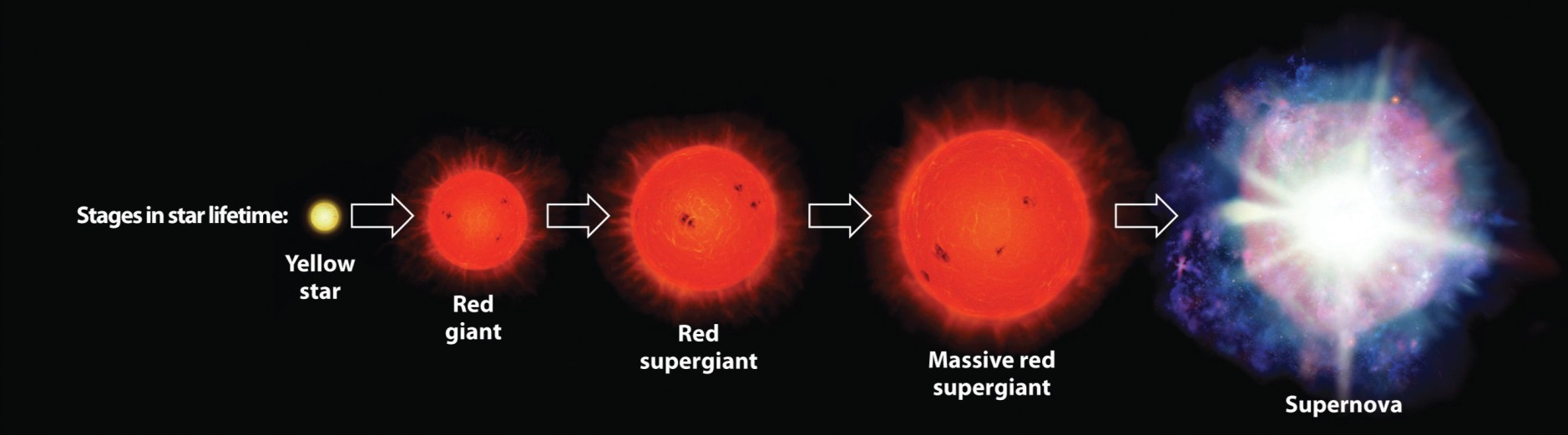
As the adolescent star matures, significant amounts of iron and nickel are formed by fusion of the heavier elements formed previously. The heaviest elements are formed only during the final death throes of the star
Thirteen centuries before stellar nucleosynthesis
The Quran was revealed to Prophet Muhammad in the 7th century CE. The theory of stellar nucleosynthesis, explaining how elements form inside stars, was not developed until 1957, when Margaret Burbidge, Geoffrey Burbidge, William Fowler, and Fred Hoyle published their paper.
The confirmation that Earth's iron originated from supernova explosions came even later, through isotopic analysis of meteorites and advances in spectroscopy during the late 20th century.
No one in 7th century Arabia had access to nuclear physics, spectroscopy, or meteorite analysis. The prevailing understanding was that iron came from the ground, because that is where people found it.
The Quran said otherwise. It used a single, specific verb that pointed upward instead of downward.
Thirteen hundred years later, science caught up.