
 Frag Hadi

The only verse in the Bible that spelled out the Trinity in plain, unmistakable language was quietly removed from modern translations after Christian scholars confirmed it was a medieval forgery. This article traces the manuscript evidence, the strange story of how the verse entered the Bible in the first place.
Two Bibles, one missing verse
Here is an experiment you can do right now. Open a King James Bible to 1 John 5:7 and read: "For there are three that bear record in heaven, the Father, the Word, and the Holy Ghost: and these three are one."
Father, Word, Holy Ghost. Three. One. That is the Trinity in a single breath.
Now open a World English Bible, or any modern critical translation, to the same verse. The WEB reads only: "For there are three who testify," and adds a footnote that is worth quoting in full: "Only a few recent manuscripts add 'in heaven: the Father, the Word, and the Holy Spirit; and these three are one. And there are three that testify on earth.'" Only a few. Recent
The ASV, WEB, and many other removed it, you can check all translations.
The scholars who prepared this translation looked at the manuscript evidence and found that the Trinitarian clause exists in none of the early Greek manuscripts. It appears only in a handful of late texts, centuries after the apostles wrote.
Compare the two translations side by side and the effect is jarring. A verse appears and disappears.
The strangest story in biblical history
The verse has a name in scholarly literature. It is called the Comma Johanneum, the Johannine Comma, and its biography is one of the strangest episodes in the transmission of any sacred text.
In 1516, the Dutch humanist Desiderius Erasmus sat down to produce the first printed Greek New Testament. He gathered every Greek manuscript he could access, and the Trinitarian clause of 1 John 5:7 was not in any of them. Not one. So he left it out.
Under pressure, Erasmus made what appears to have been a dare. He said he would put the verse back in if anyone could produce a single Greek manuscript containing it. A manuscript promptly appeared, a sixteenth century codex now known as Codex Montfortianus, held today at Trinity College Dublin (which is an almost too-perfect detail). Erasmus suspected it had been manufactured for the occasion. He added the verse to his 1522 third edition anyway, with a footnote voicing his doubts.
From there, the forged verse traveled. Into the Textus Receptus. Into the King James Bible of 1611. Into the hearts of millions of believers who lived and died quoting 1 John 5:7 as proof of the Trinity, never knowing they were quoting words no apostle ever wrote.
Bart Ehrman, in Misquoting Jesus (HarperSanFrancisco, 2005), called it "the most obvious instance of a theologically motivated corruption in the entire manuscript tradition of the New Testament."
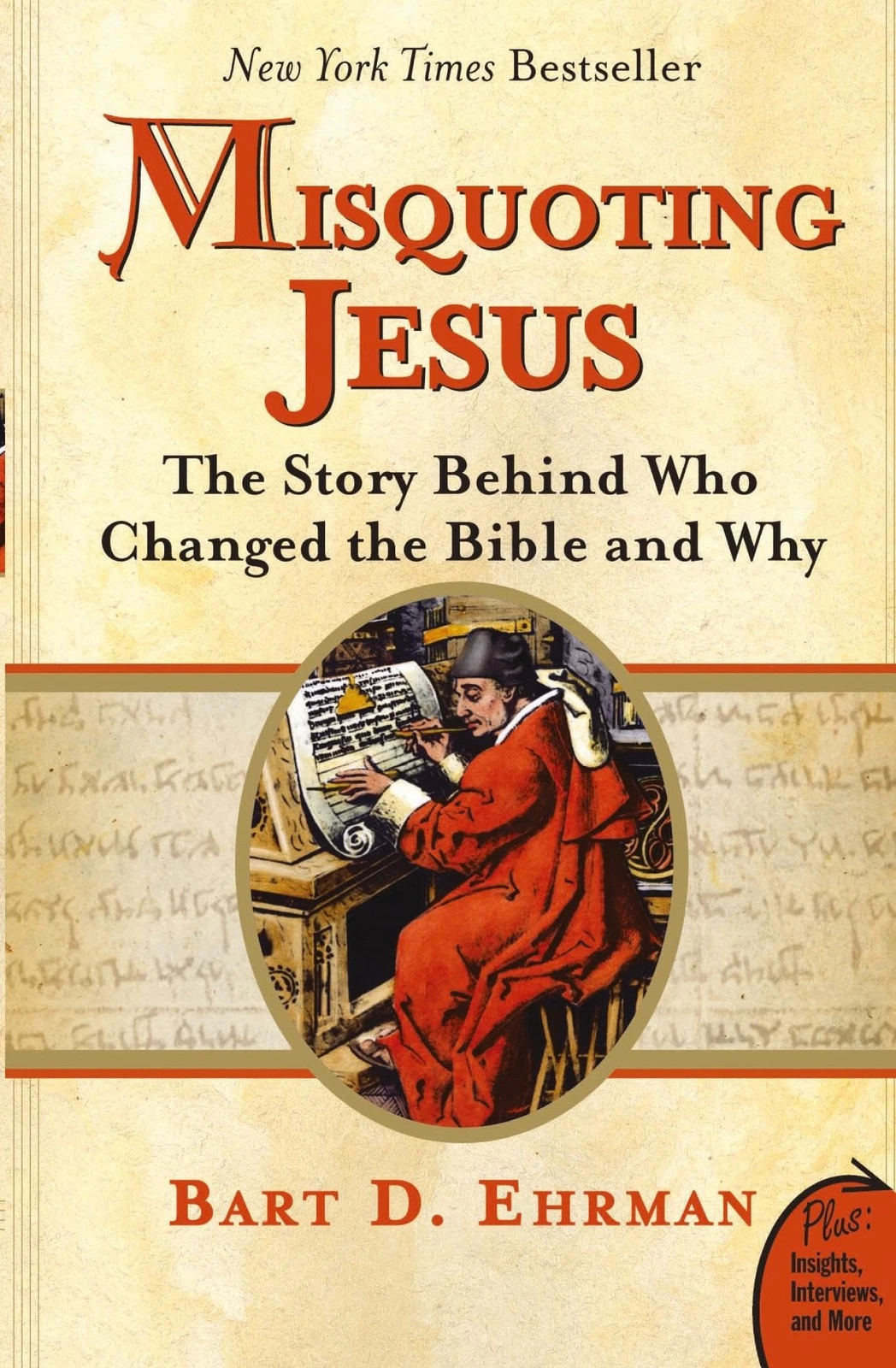
The most obvious instance of a theologically motivated corruption in the entire manuscript tradition of the New Testament
During the great Christological debates of the fourth and fifth centuries, when bishops were exiled and churches split over the precise relationship between Father, Son, and Holy Spirit, when the Council of Nicaea in 325 CE produced a creed that would define Christianity for millennia, not one theologian cited this verse. Because in their manuscripts, it did not exist.
A doctrine that has no verse
The single most explicit statement of Trinitarian theology in the entire Bible was not written by an apostle. It was inserted by an unknown hand. And when honest Christian scholarship caught up with the evidence, the verse was removed. Protestant theologian Dennis Fortin, Professor of Historical Theology at Andrews University, stated this plainly:
Apart from a known forgery, the Trinity has no explicit verse. The word "Trinity" does not appear in any book of the Bible. The Nicene Creed's homoousios, "of one substance," is a Greek philosophical term borrowed from outside the biblical tradition.
According to the Encyclopaedia Britannica, the Council of Nicaea was called by Constantine I, described as "an unbaptized catechumen," whose motivation for convening the council was as much political as theological: "he saw religious unity as essential for the political stability of his newly unified empire."
I keep coming back to this act. Not with anger. With something closer to sadness. Because it tells you everything. It tells you there was a gap between what Jesus said and what the tradition needed him to have said. A gap so unbearable that someone felt compelled to fill it with a lie.
What Jesus himself taught about God
There is an exchange in the Gospel of Mark that is about more than almost any other passage in the New Testament. A scribe approaches Jesus and asks: which commandment is the most important?
The Shema. The oldest, deepest declaration in Jewish faith. God is one. Not three. Not three in one.
The scribe replies:
No other besides Him. Strict, unqualified monotheism.
In John 17:3, Jesus prays:
Two distinct categories. "Thee," the only true God. "Me," the one you sent. The sender and the sent are not the same.
The Quran, and trinity.
A forged verse, debated for centuries, removed by committee, and the doctrine it supported still has no clear scriptural foundation. The Qur'an's response to all of this fits in four lines that every Muslim child memorizes before they learn anything.
The Prophet Muhammad PBUH had watched this pattern across the entire arc of prophetic history. He refused to let it happen twice.
What remains when the forgery is removed
Someone looked at the Bible and found it lacking. Found that the doctrine they held most dear did not have a single verse to stand on without ambiguity. And instead of questioning the doctrine, they altered the scripture. When that verse was finally identified and pulled from translation after translation, the doctrine did not fall. It floated free, sustained by inertia, by the accumulated weight of centuries.
The Qur'an offers something different. Not a doctrine that needed a forgery to find its footing, but a truth so simple it has never been amended:
He is Allah, the One.
Perhaps the reason 1 John 5:7 had to be forged is that what it tried to say was never true. And perhaps the reason Surah Al-Ikhlas has never needed to be forged is that what it says has always been enough.
